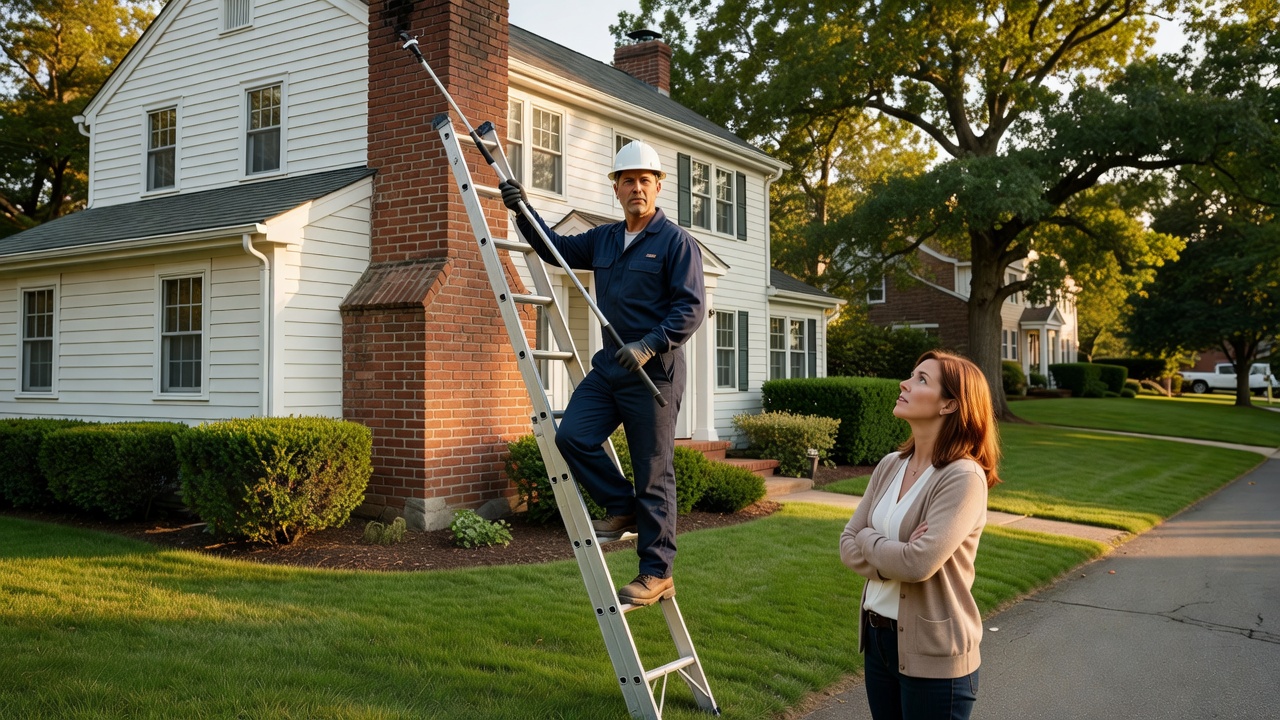
Creosote Removal Greenvale NY: When to Schedule It and What You Can Skip
Most homeowners in Greenvale and Old Brookville know that creosote can become a problem in a wood-burning chimney. What is less clear is what homeowners can safely handle themselves, when professional cleaning is appropriate, and whether there is a particular time of year when the work should be scheduled.
Creosote forms when smoke from burning wood cools and condenses on the inside of the chimney. The resulting residue can range from ordinary soot and creosote deposits to hard or glazed material that is more difficult to remove. Creosote is combustible, so significant accumulation should not be ignored.
What Creosote Is and Why It Builds Up
Creosote develops when combustion byproducts condense on cooler chimney surfaces. Restricted airflow, unseasoned wood, and prolonged smoldering can increase the conditions that contribute to buildup.
The type and amount of deposit can vary considerably from one chimney to another. Some deposits can be removed through standard mechanical sweeping. Hard or glazed deposits may require more specialized mechanical cleaning, and a qualified professional may use chemical products as part of the cleaning process. CSIA specifically notes that chemical cleaners do not replace mechanical sweeping.
There is no reliable evidence that Greenvale or Old Brookville homes universally accumulate creosote faster because of a particular local microclimate or heating season. How quickly a chimney accumulates deposits depends more directly on the appliance, fuel, frequency of use, burning practices, chimney design, and operating conditions.
What Can a Homeowner Safely Handle?
There are several maintenance tasks homeowners can reasonably perform.
Cleaning cooled ashes from the firebox is one example. Homeowners can also check that the damper operates properly, follow the appliance manufacturer’s instructions, and make sure they are burning appropriate firewood.
EPA recommends burning dry, seasoned wood with a moisture content of 20 percent or less. It also recommends avoiding prolonged smoldering fires and never burning garbage, plastics, or pressure-treated wood.
What homeowners should not do is assume that a small amount of visible residue tells them everything about the condition of the chimney.
CSIA notes that ordinary deposits can sometimes be addressed through standard brushing, while hard or glazed deposits may require specialized mechanical equipment. Improper use of mechanical cleaning equipment can be hazardous to both the operator and the chimney.
For that reason, homeowners should be cautious about attempting to clean difficult deposits from an inaccessible or unfamiliar flue.
Does Creosote Have Three Official Stages?
Not in the way the original article suggests.
Terms such as “Stage 1,” “Stage 2,” and “Stage 3 creosote” are often used in consumer-facing chimney content, but they should not be presented as formal NFPA classifications.
A more useful description is the condition of the deposit. Soot and ordinary creosote can behave differently from hard, tacky, or glazed deposits. CSIA states that standard brushing is effective for ordinary deposits but has little effect on glaze. More difficult deposits may require mechanical cleaning or chemical treatment used in conjunction with mechanical sweeping.
This distinction matters because the cleaning method should be based on what is actually present rather than an assumed “stage.”
When Should You Schedule Creosote Removal?
There is no universal month that is automatically the best time to clean every chimney.
For homeowners who use a wood-burning fireplace, scheduling an inspection before the heating season can provide time to address cleaning or repairs before regular use begins. But a chimney that has significant buildup or another safety problem should not be left until fall simply because that is the traditional scheduling window.
CSIA follows NFPA guidance recommending that chimneys, fireplaces, and vents be inspected at least once a year. Cleaning, maintenance, and repairs should be performed when necessary.
The timing of the cleaning itself depends on the amount of use and the condition of the chimney.
Late Summer
Late summer can be a convenient time to schedule an inspection or cleaning because many homeowners have not yet started using their fireplaces regularly.
However, there is no reliable basis for claiming that August or early September is always the cheapest period or that every Nassau County chimney company will have shorter wait times.
The advantage is primarily practical. Completing maintenance before regular fireplace use gives you more time to address problems that are discovered.
Fall
Fall is a common time for homeowners to schedule chimney maintenance.
If you plan to use a wood-burning fireplace, scheduling before the first fire gives you an opportunity to address buildup, masonry problems, damaged components, or other issues before the appliance is needed.
There is no need to wait for a particular date on the calendar if the chimney already shows signs of a problem.
Winter
Winter is not too late to address a chimney problem.
If you notice a strong smoke odor, visible deposits, unusual fireplace behavior, or another warning sign, do not postpone evaluation simply because the heating season has started.
EPA advises homeowners who smell smoke inside the home to stop using the wood-burning appliance and have the system evaluated.
Spring
Spring can also be a practical time to evaluate a chimney after a period of regular use.
If an inspection identifies masonry deterioration, liner problems, or other repairs, completing the work before the next heating season may give you more time to plan the project.
Spring is not, however, a mandatory cleaning season. The appropriate schedule depends on the chimney’s actual condition and use.
When Does a Chimney Need Cleaning?
There is no single cleaning schedule that applies to every chimney.
CSIA recommends that masonry fireplaces be swept when sooty buildup reaches approximately 1/8 inch, or sooner when glaze is present. CSIA also notes that cleaning frequency depends on use, fuel, installation, and burning habits.
That means a homeowner should not assume that every chimney needs exactly one cleaning per year or that burning a specific number of cords automatically determines the cleaning date.
Regular inspections help determine when cleaning is actually necessary.
What Happens If You Wait?
Creosote buildup can increase over time when the conditions that produce it continue.
The risk is not simply that the chimney will become harder to clean. Significant creosote is combustible and can contribute to chimney fires. CSIA identifies chimney fires as a reason for concern because they can damage chimney components and create additional safety problems.
Delaying maintenance can also allow other problems to remain unnoticed. An inspection may reveal masonry deterioration, damaged flue components, blockages, or other conditions that are not visible from the fireplace opening.
The solution is not to assume that every buildup will progress through three specific stages. The better approach is to inspect the chimney regularly and clean it when the amount or type of deposit requires it.
What About the Cost of Creosote Removal?
There is no reliable Greenvale or Old Brookville price range that applies to every creosote-removal job.
The cost can depend on the amount and type of deposit, chimney height, accessibility, equipment required, appliance type, and whether additional inspection or repair is necessary.
Hard or glazed deposits may require more specialized cleaning than ordinary soot. If an inspection also identifies a damaged liner, masonry problem, crown deterioration, or another repair, that work would be separate from routine cleaning.
Ask for a written explanation of what the contractor found and what is included in the proposed service rather than relying on a generic online price.
Do You Need a Level 2 Inspection?
Not automatically.
A Level 1 inspection is used for routine situations when the chimney and appliance configuration have not undergone a significant change and the accessible portions can be adequately evaluated.
A Level 2 inspection is more extensive and may be appropriate when circumstances call for additional evaluation. Examples can include a property transfer, a change in the appliance or fuel type, a chimney or building fire, an operating malfunction that may have damaged the system, or circumstances where a Level 1 inspection cannot determine the chimney’s serviceability.
Therefore, simply having used a fireplace heavily during the winter does not automatically mean that a Level 2 inspection is required.
How to Reduce Creosote Buildup
Homeowners can reduce conditions that contribute to creosote formation by:
-
Burning dry, seasoned firewood.
-
Using wood with a moisture content of 20 percent or less.
-
Avoiding prolonged smoldering fires.
-
Providing appropriate airflow.
-
Following the appliance manufacturer’s operating instructions.
-
Having the chimney inspected regularly.
-
Cleaning the chimney when deposits warrant it.
Do not burn garbage, plastics, painted wood, or pressure-treated wood in a wood-burning appliance. These materials can produce harmful substances and may damage the appliance.
Creosote Removal Greenvale NY: What Homeowners Should Know
For homeowners in Greenvale, Old Brookville, and nearby Nassau County communities, the important question is not whether there is one perfect month for chimney cleaning.
The better question is whether the chimney has been inspected and whether its condition indicates that cleaning or other maintenance is needed.
If you burn wood regularly, schedule an annual inspection and address significant deposits when they are identified. If you notice smoke entering the home, unusual odors, visible buildup, or changes in fireplace performance, do not wait for the next convenient season to have the system evaluated.
A professional inspection can determine whether the chimney needs routine sweeping, more specialized creosote removal, additional inspection, or repair.
Related from Greenvale Chimney: Chimney Repair in Greenvale, NY · Chimney Repair in Greenvale